
Date Published: 9th July 2026
Date Modified: 30th July 2026
Author: Dr Wendy Sweet (PhD)
At a Glance
Oestrogen dominance in menopause is a term used to describe an imbalance between oestrogen activity and progesterone, particularly as visceral fat increases. During menopause, hormonal changes alter the way women store fat, and metabolically active fat tissue may influence oestrogen metabolism, insulin resistance and inflammation. Understanding these changes helps explain why menopause weight gain is more complex than simply eating less and exercising more.
Video: Oestrogen Dominance In Menopause Explained
In this short video, Dr Wendy Sweet explains how fat cells can store and produce oestrogen during menopause, including the role of oestrone, visceral fat, liver function, gut health and sleep.
Understanding the Secret Life of Deep Visceral Fat
The perplexity of my weight gain during menopause, kept me busy in the research books for years. I couldn’t understand, why, since starting on HRT many years ago, I began to put on weight. Now, no longer on it, the response I had (compared to many other women) opened up my academic insights into the secret life of fat cells, and how, when we develop deeper fat cells, there is a shift in the response of these fat cells, to both store and produce oestrogen, helping explain why many researchers discuss oestrogen dominance in menopause in relation to increasing visceral fat.”
Fat cells in women are replete with oestrogen receptors, making them central to understanding oestrogen dominance in menopause and post-menopause. These receptors constantly seek out any forms of oestrogen circulating in the blood that they can – oestrogens that are recycled from the gut from animal foods, chemical exposure, alcohol, medications and yes, fat cells are now known to also produce a form of oestrogen called oestrone.
Your fat cells indeed have a secret life.
But there is more to this story too and that includes the fact that for many women going through menopause and into their post-menopause years, there is an acceleration and change in distribution of fat cells to become more centrally located around the abdomen. This is the deeper fat that can become harmful to our cardiovascular health.
When fat cells become saturated with oestrogen, and women are putting on weight, they become ‘dominant’ in oestrogen compared to the opposing hormone, called progesterone. A condition known as ‘oestrogen dominance’.
Then there is something else as well, thanks to a small study on a group of Danish women.
Imagine being a subject in a study whereby you are not only undergoing minor gynae surgery, but you’ve also given your permission for the surgeon to do a biopsy of your fat cells under your skin (subcutaneous adipose tissue) as well as the fat cells deeper around your organs (visceral fat).
I would like to thank the lovely peri-menopausal and post-menopausal women in Denmark who consented to this. It helps me to help those of you in post-menopause better understand why you are putting on abdominal and diaphragmatic fat, that your current exercise and dieting may not be shifting.
Whilst the study was a small one (no surprises there), the subjects (women between the ages of 45-60 years) helped scientists to broaden their understanding about menopausal and post-menopause fat changes and obesity.
The study found that our menopause transition was associated with changes in the characteristics of fat cells (adipose tissue) and this is related to metabolic dysfunction.
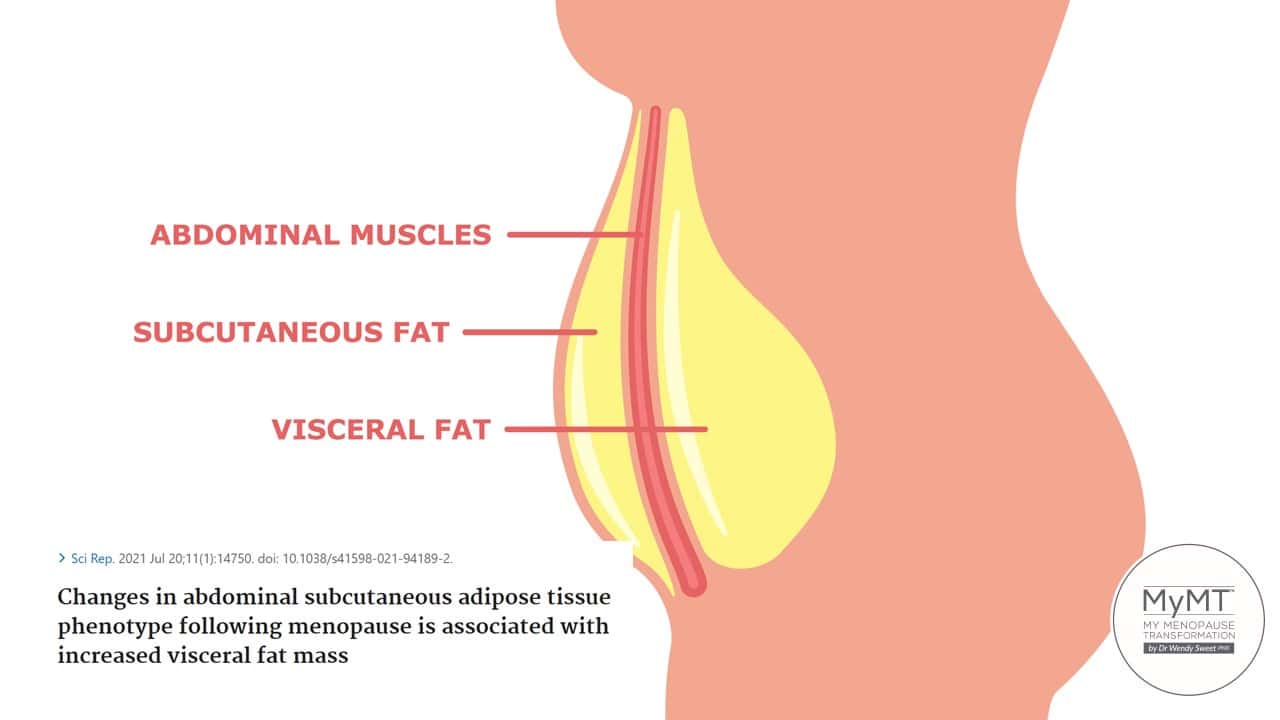
In menopausal and post-menopausal women (when periods have ceased for a year or more), the subcutaneous fat nearer the skin showed fat cell enlargement (hypertrophy), increased inflammation and lack of oxygen (hypoxia).
These subcutaneous fat changes then led to an increase in fat storage more deeper in the abdominal region – the type of fat that is called visceral fat. (Abildgaard, Ploug et al, 2021). As the authors mentioned,
“For a given total fat mass, postmenopausal women store significantly more VAT (visceral adipose tissue) than pre-menopausal women.” (p. 1).
The authors believe that the mechanisms behind the redistribution of fat as women move through menopause into post-menopause may be due to spillover of lipids (fats) from subcutaneous fat stores and then these are re-directed towards less favourable locations deep inside the abdomen.
These deeper fat stores are known as visceral fat … and for women who are post-menopause, this type of fat may lead to changes to insulin levels and increasing circulatory inflammation too.
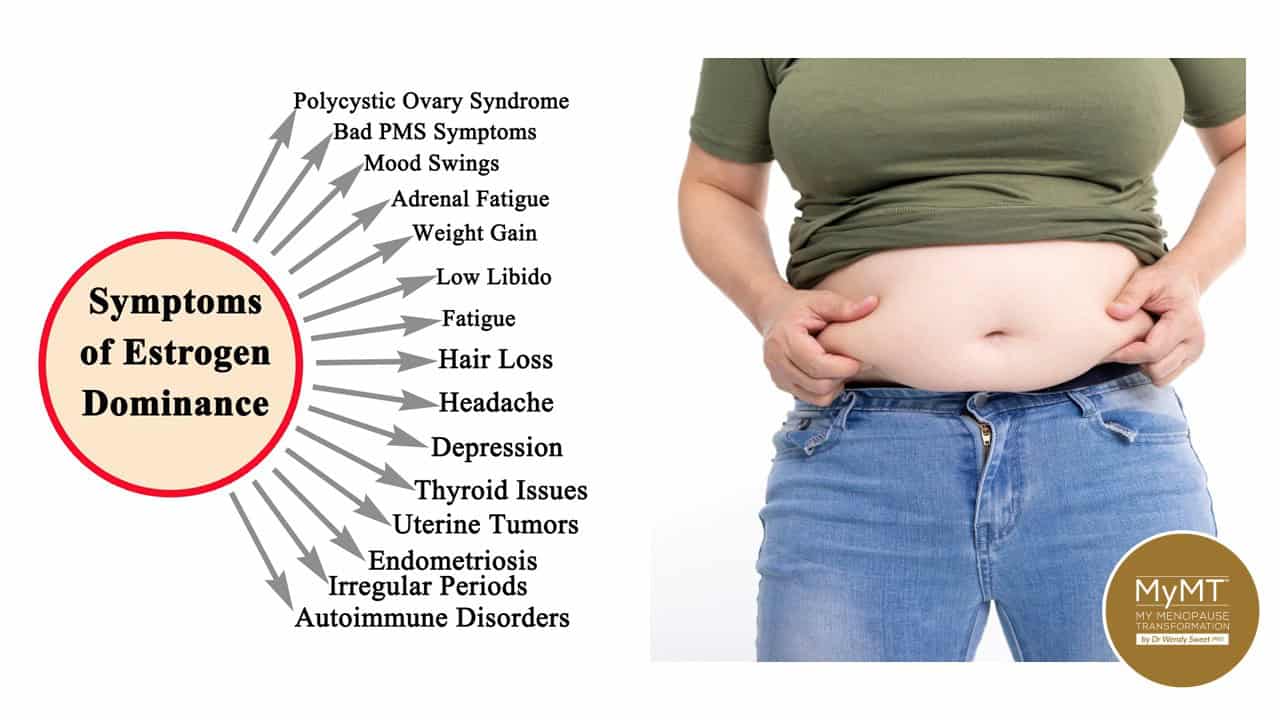
What is Oestrogen Dominance in Menopause?
But here’s the curiosity. One explanation for oestrogen dominance in menopause lies in the changing biology of fat cells. When women develop deeper visceral fat around the abdomen (as I did too), the fat cells change in ways that causes them to make different types of oestrogen.
These different types of oestrogen are oestrone and oestradiol and in many women putting on a lot of belly-fat, this additional production of oestrogen contributes to the deeper visceral adipose tissue.
As such, Hetemäki, Savolainen-Peltonen, et al, (2017) have suggested that as women acquire more deep visceral fat stores and the fat cells expand, overall higher oestrogen exposure in menopausal and post-menopausal women can occur. These higher levels of oestrogen can also upset the balance of the master pituitary hormone, Follicle Stimulating Hormone, [Fenton, 2021] and contribute to an imbalance with progesterone.
Despite a challenge to the term ‘oestrogen dominance‘ these days by some popular journalists writing about menopause, what they may not understand is that when we are specifically talking about fat cells and their secret life, then these fat cells become dominant in oestrogen storage, compared to progesterone.
I refer to this in my 2 hour Masterclass on Menopause in a way that describes how fat cells which produce and store oestrogen, expand and become enlarged (this term is called ‘hypertrophy’).
This contributes to localised production of oestrogen in fat cells in women who are overweight and obese. These women have more fat cells than thinner, leaner women, so the two different body-types cannot be compared.
As such, overweight women in their menopause transition may become ‘dominant’ in oestrogen storage in their body. When this happens, and weight around the belly and diaphragm continues to increase, post-menopausal women especially, may head down the slippery slope towards metabolic chaos and Type 2 diabetes, which the wrong type of diet and exercise doesn’t necessarily shift.
Not Sleeping is Problematic for Weight Loss
Menopause and post-menopause weight gain is tricky to navigate. This is especially so, if women are not sleeping and they have also developed gut health concerns, since starting HRT.
This is a similar pattern in younger women on the contraceptive pill – excess oestrogens can change the part of the gut microbiome, called the oestrobolome. [Hu et al., 2023]. Oestrogen levels influence the composition as well as the diversity of gut microbiota, so if oestrogen levels are too high in the gut, then many women start to develop gut dysbiosis – something I’ve noticed with women on the MyMT programmes over the years.
This is where sleep is important. When women aren’t sleeping, their gut isn’t healing and fat cells, which are also on a circadian pattern, stay inflamed. Sleep is crucial for fat loss. This is why, I always tell women on my 12 week programmes that if they want to lose weight, then they must attend to their sleep patterns first.
When it comes to weight loss in menopause and beyond, I often say in my coaching programmes that menopause itself isn’t the issue. This is a natural life stage that we all go through. The issue is that our cells and tissues are changing with age, and this includes our gut, liver and fat cells.
Because we are ageing, we are not only experiencing changes to characteristics of fat cells, but declining oestrogen (and the master pituitary hormones), also impact our muscle density and function.
For women in their menopause transition, (whether they are on HRT or not), this becomes a double-whammy – fat cells are expanding and muscle tissue is becoming less metabolically active. These two issues combined, may mean that fat becomes increased around the abdomen and deep visceral fat storage changes.
But here’s the problem – increased visceral fat impacts cardiovascular health as we get older. For many women, they also develop even more gut health problems and bloating. And because of the connection between the gut and the brain, then this may lead to symptoms of melancholy and depression in women too.
Incredibly, because of the combination of additional fat cell storage and hypertrophy (growth) and some muscle loss and gut health problems, this can add 1-2 kg a week during menopause, with much of this going on our belly and under our diaphragm.
Then, if we aren’t sleeping, or our joints feel sore, or our gut health is changing, it’s hard to get on top of how to lose weight or, as I mention to women on my programme, “you must firstly, stop gaining.”
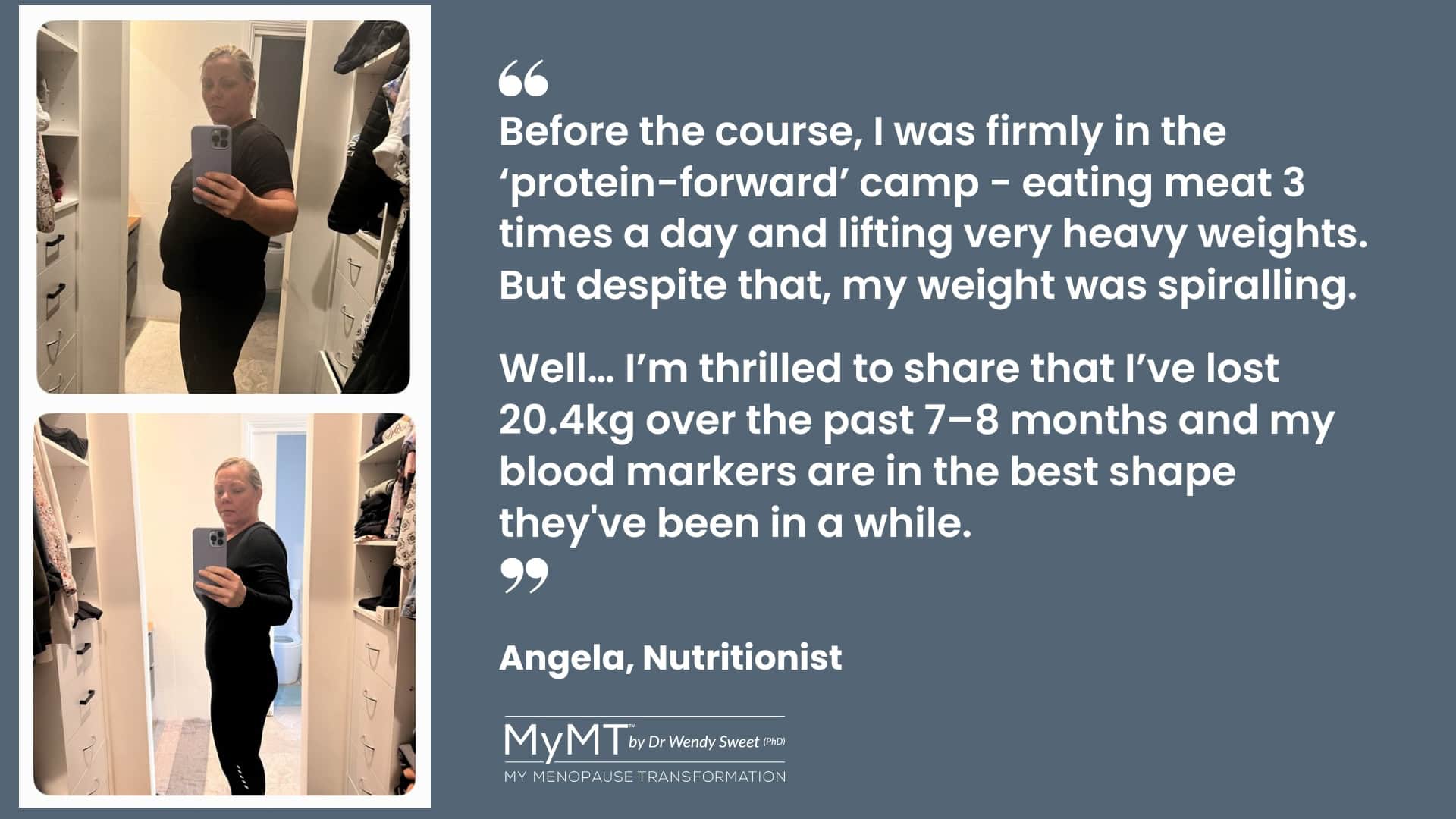
The women who join me on the MyMT™ Transform Me programme, know that turning around post-menopause belly-fat has nothing to do with hours spent exercising, or low carb, high protein, high fat, hard-to-adhere to, popular diets.
It’s all to do with sleeping all night and reducing their oestrogen dominance, as well as turning around gut and liver health, so that they stop gaining fat.
Then it’s about balancing blood-sugar levels and reducing the impact of insulin, our blood sugar regulation hormone.
Along the way, women also need to focus on helping their liver health to excrete oestrogens into the bile. If women don’t have a gallbladder, then this is also problematic. All excess oestrogens in the body are excreted via bile into the small intestine, and may be recycled all over again, unless we improve our gut health and change our diet to specifically allow excess oestrogens to be excreted via waste.
This is why, for many women, they find it confusing as to why doing lots of exercise doesn’t necessarily help them to lose their belly-fat.
The starting point for menopause weight loss lies with sleeping all night and the health of the liver and gut, not undertaking lots of exhausting exercise and fasting regimes that are promoted today.
Tips for Managing Menopause Weight Gain
If you are as bewildered as I was, here’s the real (and new) science behind managing your menopause and post-menopause weight gain:
1. SLEEP ALL NIGHT: Not sleeping increases your blood-sugar hormone called insulin – both overnight and during the day. The role of insulin is to shift glucose around your body, especially to your brain, liver and muscle cells where it gets stored in your cells. But when we don’t sleep, our blood pressure and heart rate remain higher during the day, which in turn increases two hormones which impact weight gain – insulin and our chronic stress hormone, called cortisol. To lose belly-fat and change our risk for Type 2 diabetes in post-menopause, both insulin and cortisol need to be low, especially at night. If they remain high, they interfere with the production of your sleep hormone called ‘melatonin‘.
As we prepare to go to sleep and stay asleep, then melatonin levels should be as high as they can be.
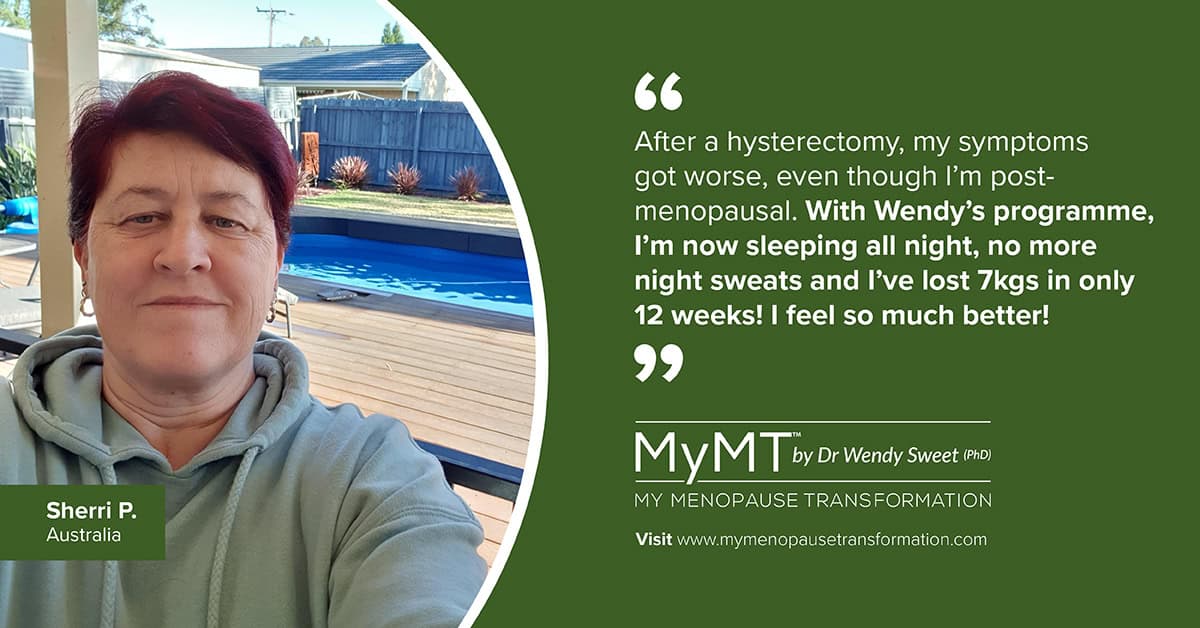
This is why I teach women what to do to achieve the right balance between melatonin and insulin production as part of the first module they listen to in their private learning area on the 12 week MyMT™ Transform Me programme.
If you want to start losing weight, you must sleep.
2. REDUCE STRESS IN YOUR LIFE! In post-menopause, testosterone production increases if you still have your ovaries – this disrupts insulin and cortisol. Your body is amazing. Never forget that. As women going into post-menopause, if we still have our ovaries, we are producing some testosterone.
If you are feeling stressed and overwhelmed, day after day, then this impacts cortisol and testosterone production too. Managing your stress levels is an important part of menopause weight management.
We all have varying degrees of testosterone being produced as we age and some of you stronger, larger ladies with an adrenal or pituitary body-type might produce more as well.
But levels of this hormone go UP when you are feeling stressed, causing even more production of your stress hormones, including your chronic stress hormone known as cortisol. The powerful combination of higher testosterone and high cortisol keeps your belly fat increasing.
Testosterone is an androgen, or sex-related hormone.
It is produced in your ovaries, adrenal glands and fat cells. In women, testosterone contributes to over 200 actions in our body, from muscle development, to growing facial hair on our chins, to influencing anger and frustration.
In natural menopause, androgen levels don’t suddenly drop, but at this time of life, you are producing about 50% less than in puberty, which is often the cause of women losing their libido and mojo at this time as well!
But there is something else affecting your weight gain during menopause as well – your decline in muscle.
I call it the ‘forgotten factor’ in understanding menopause weight gain.
A condition called sarcopenic obesity due to muscle changes may arrive during menopause and into post-menopause. Furthermore, sore joints may be preventing you from doing the aerobic exercise you need to do, in order to reduce insulin resistance.
If we aren’t sleeping, then the muscle loss speeds up as your metabolism changes because you aren’t getting the benefit of muscle recovery overnight – even for those of you doing weights.
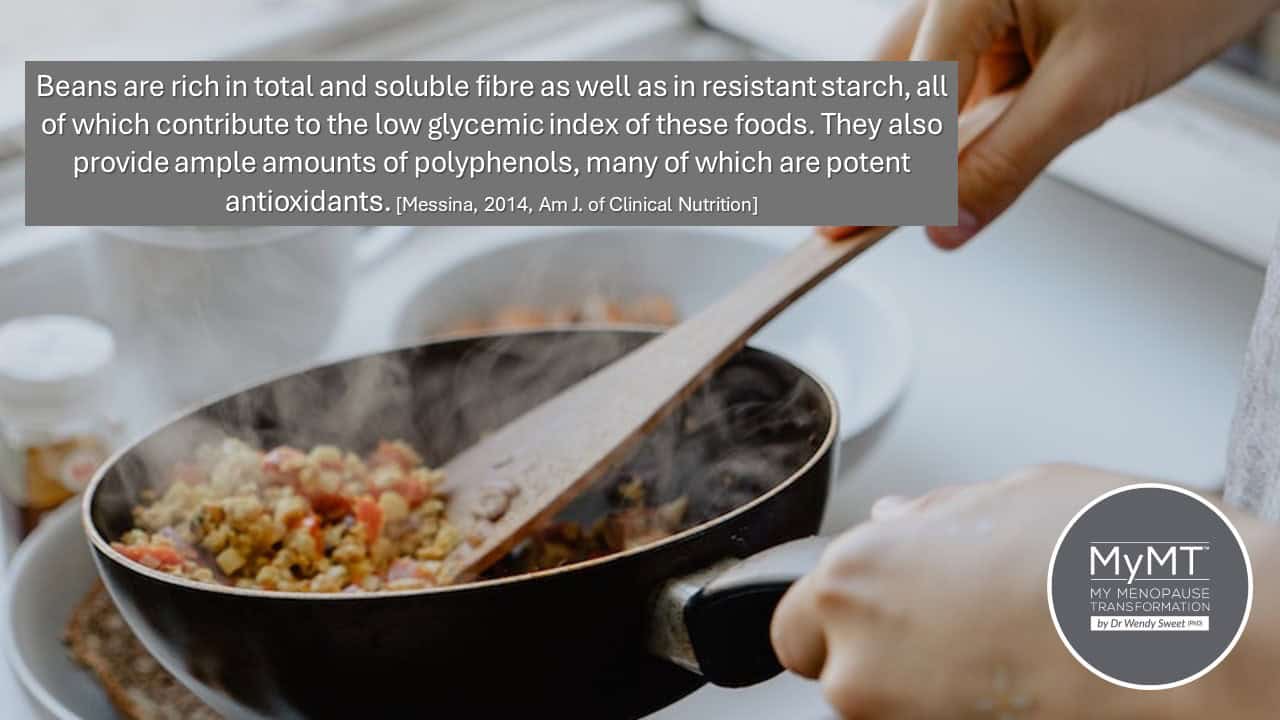
3. Focus on FIBRE: Fibre, especially soluble fibre, is important for excess oestrogen excretion in the gut. If your fibre intake is low, then stay focused on this for your weight loss too.
“It’s important to understand how women’s bodies change as they age because women have higher rates of some diseases than men”, said Ananthan Ambikairajah, a PhD candidate at the Australian National University, investigating changes to fat mass in women.
“The implications are important, because central fat has been linked with dementia risk, and central fat is linked with cardiovascular disease risk. More attention needs to be paid to central fat accumulation, because that’s the bad stuff,” mentioned Ambikairajah.
ALL of these factors combined – oestrogen dominance, insomnia, increased insulin, high stress levels, testosterone changes and loss of muscle tissue – have the greatest impact on our changing health and weight gain as we move into post-menopause. These health changes impact a condition called ‘Metabolic Syndrome’.
I would love you to transition through menopause and into post-menopause using the powerful lifestyle strategies which I’ve researched specifically to help you manage your symptoms and turn around the weight that may have stacked on as it did for me too.
I called the 12 week weight loss programme ‘Transform Me’ because that’s what I wanted to achieve during menopause when I felt bloated and uncomfortable and exercise and nutrition wasn’t shifting my weight as it used to do for years.
After I looked into menopause and positioned it in women’s healthy ageing studies, I began to understand why.
FAQs: Oestrogen Dominance
Yes. Fat cells are biologically active and produce oestrone, a naturally occurring form of oestrogen. As visceral fat increases during menopause, this local hormone production may contribute to changes in metabolism, inflammation and body composition.
Hormonal changes during menopause alter where fat is stored. Many women develop more visceral fat around the abdominal organs rather than beneath the skin. This shift is associated with insulin resistance, chronic inflammation and an increased risk of metabolic syndrome, cardiovascular disease and Type 2 diabetes.
Visceral fat is fat stored deep within the abdomen around internal organs. Unlike subcutaneous fat beneath the skin, visceral fat is metabolically active. It produces hormones and inflammatory compounds that can affect blood sugar regulation, cardiovascular health and overall metabolic function.
The gut microbiome helps regulate how oestrogen is metabolised and excreted. When gut health is compromised, excess oestrogen may be reabsorbed into the bloodstream instead of being eliminated, potentially influencing hormonal balance.
Yes, although it often requires a different approach than earlier in life. Improving sleep quality, managing stress, supporting liver and gut health, maintaining muscle mass through regular exercise and following a nutrient-rich diet can help reduce visceral fat and improve metabolic health over time.
Supporting healthy sleep, managing stress, eating adequate dietary fibre, maintaining muscle mass, improving gut health and promoting healthy liver function may help support normal oestrogen metabolism and overall hormonal balance during menopause.
References:
Ambikairajah, A., Walsh, E., Tabatabaei-Jafari, H., & Cherbuin, N. (2019). Fat mass changes during menopause: a metaanalysis. American Journal of Obstetrics and Gynecology, 221(5), 393-409. https://doi.org/10.1016/j.ajog.2019.04.023.
Abildgaard J., Ploug T., Al-Saoudi E., Wagner T., Thomsen C., Ewertsen C., Bzorek M, Pedersen BK, Pedersen AT., & Lindegaard B. (2021). Changes in abdominal subcutaneous adipose tissue phenotype following menopause is associated with increased visceral fat mass. Sci Rep. 11(1):14750. doi: 10.1038/s41598-021-94189-2. PMID: 34285301; PMCID: PMC8292317.
Brittain RSA, Bribiescas RG, Jasienska G. Industrialization increases the estrogen-recycling capacity of the gut microbiome. Proc Natl Acad Sci U S A. 2026 Apr 21;123(16):e2523589123. doi: 10.1073/pnas.2523589123. Epub 2026 Apr 13. PMID: 41973926; PMCID: PMC13099636.
Edwards, B. & Jin Li, [2013]. Endocrinology of menopause. Periodontology, 61, 177–194.
El-Zayat, S.R., Sibaii, H. & El-Shamy, K.A. Physiological process of fat loss. Bull Natl Res Cent 43, 208 (2019). https://doi.org/10.1186/s42269-019-0238-z
Fenton A. Weight, Shape, and Body Composition Changes at Menopause. J Midlife Health. 2021 Jul-Sep;12(3):187-192. doi: 10.4103/jmh.jmh_123_21. Epub 2021 Oct 16. PMID: 34759699.
Ford, C. et al. [2017]. Evaluation of diet pattern and weight gain in postmenopausal women enrolled in the Women’s Health Initiative Observational Study. British Journal of Nutrition, 117, 1189–1197.
Harvard Health, [2018]. Lose weight and keep it off. Harvard Health Online Publications. Boston: MA
Hetemäki, N., Savolainen-Peltonen, H., Tikkanen, M. Feng Wang, Paatela, H. et al. (2017). Estrogen Metabolism in Abdominal Subcutaneous and Visceral Adipose Tissue in Postmenopausal Women. The Journal of Clinical Endocrinology & Metabolism, 102, (12), 4588–4595, https://doi.org/10.1210/jc.2017-01474
Hu S, Ding Q, Zhang W, Kang M, Ma J, Zhao L. Gut microbial beta-glucuronidase: a vital regulator in female estrogen metabolism. Gut Microbes. 2023 Jan-Dec;15(1):2236749. doi: 10.1080/19490976.2023.2236749. PMID: 37559394; PMCID: PMC10416750.
Kendall, B. & Ester, R. [2002]. Exercise-induced muscle damage and the potential protective role of estrogen. Sports Med., 32 (2), 103-123
Lerchbaum, E. [2014]. Vitamin D and Menopause: A review. Maturitas, 79, 3-7.
Moudi, A. et.al [2018]. The relationship between health-promoting lifestyle and sleep quality in menopausal women. Biomedicine, 8(2), 34-40.
Rizzi, M. [2016]. Sleep disorders in fibromyalgia syndrome. J. of Pain & Relief, 5:2.
Ryan, M. Itsiopoulos, C. et al. (2014). The Mediterranean diet improves hepatic steatosis and insulin sensitivity in individuals with non-alcoholic fatty liver disease. Journal of Hepatology, 59(1), 138-143.
Santosa, S. & Jensen, M. (2013). Adipocyte fatty acid storage factors enhance subcutaneous fat storage in postmenopausal women. Diabetes, 62,3, 775-782, ProQuest Central.
Saravinovska K, Santi D, Costantino F, Prete A, Šojat AS, Spaggiari G, Ivović M, Lambrinoudaki I, Armeni E, Jurišić A, Mihajlović S, Vujović S and Marina LV (2026) The impact of estrogen status on the gut microbiome: a systematic review and meta-analysis. Front. Endocrinol. 17:1780806. doi: 10.3389/fendo.2026.1780806
Zengul AG, Demark-Wahnefried W, Barnes S, Morrow CD, Bertrand B, Berryhill TF, Frugé AD. Associations between Dietary Fiber, the Fecal Microbiota and Estrogen Metabolism in Postmenopausal Women with Breast Cancer. Nutr Cancer. 2021;73(7):1108-1117. doi: 10.1080/01635581.2020.1784444. Epub 2020 Jun 26. PMID: 32590914; PMCID: PMC7875566.