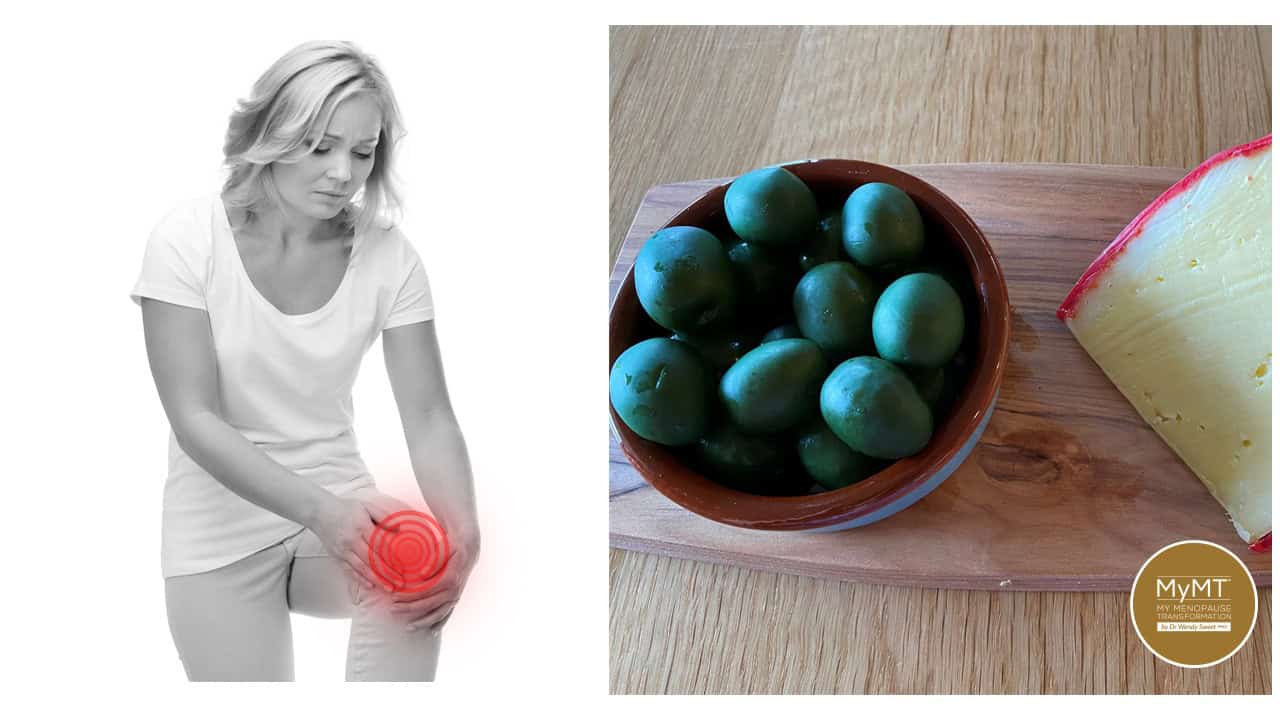
Sore joints? Aching Muscles? Restless Leg Syndrome? Why?
Perhaps your leg cramps are waking you up at night – a phenomenon known as ‘Restless Leg Syndrome’?
Maybe you’re a regular exerciser and don’t understand why your recovery between workouts is taking longer than it used to?
Perhaps you find that you can’t climb up and down the stairs as easily as you used to, or you can’t move as freely as you would like … you’ve started to slow down because of your aching muscles and joints?
Or maybe you’re taking a heap of turmeric and glucosamine and other supplements targeted towards women in middle age and older, hoping for the relief that you deserve?
Over 80% of 500,000 women globally who have undertaken the MyMT™ Symptoms Quiz, report that they have sore joints.
I’m not surprised – especially with the emphasis these days on heavy weight training and higher protein diets for midlife women. This ability to tolerate exercise is not the reality for many midlife women.
As I also mentioned to the Health Practitioner’s currently undertaking the Menopause and Lifestyle Science certification with me, there is a missing connection here – and that is, that women may not be getting the basics of their nutrition and other lifestyle changes sorted out, before embarking on a lot of exercise, especially if they aren’t sleeping or have gut health concerns.
Women on my own doctoral studies were the same … as I was too – i.e., turning to heavy exercise, but not understanding that their muscles and joints are changing during menopause, but experiencing worsening symptoms.
The Muscle-Calcium Connection in Menopause
We need 1200mg a day. Every day.
That’s the amount of calcium we need from our 50’s onwards. But whilst we’ve all been told that it’s to do with our bone health, I beg to differ. Because calcium’s role in the body is not just about our bones and teeth.
If you are a women in her mid-life transition who either exercises regular or you are in a physically demanding job, then your calcium intake is not only about your bones, it’s about your muscles as well.
And yes, I include your heart muscle and the tiny smooth muscles that make up your blood vessels in this comment. They need calcium too.
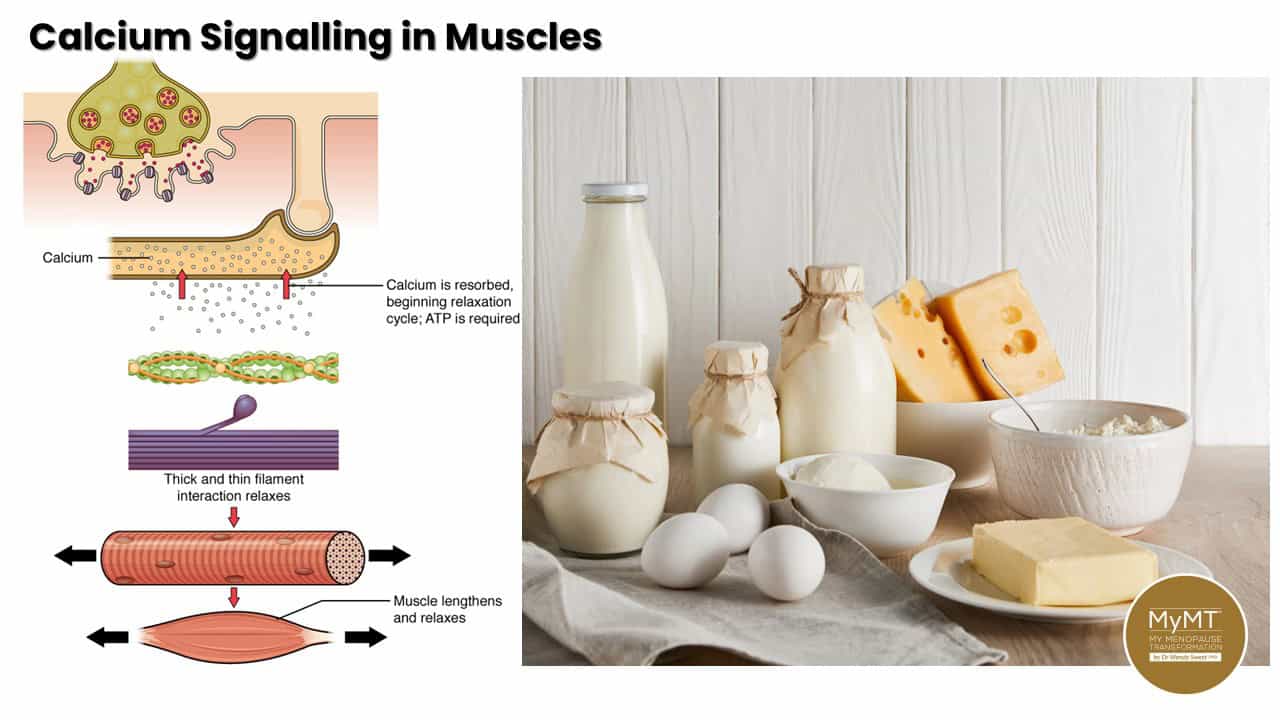
Calcium is needed for nerve action and muscle contraction
Calcium as a nutrient, is most commonly associated with the formation and metabolism of bone. With over 99 percent of total body calcium found as calcium hydroxyapatite in bones and teeth, it provides hard tissue with its strength.
But whilst the emphasis for women in menopause and post-menopause has primarily been about calcium for bone health, there’s another reason that it’s important.
Calcium is critical for controlling the contraction and dilation of your blood vessels. It’s also crucial for muscle contraction because of its role in helping the nerve electrical current to ‘jump’ across the gap between the nerve and the muscle, which you can see on the image below.
Optimal Vitamin D levels Assist Calcium Absorption
It’s not ‘just’ about calcium in food either. Optimal Vitamin D levels are crucial to maintain during your menopause transition too. Hence, food sources of Vitamin D are important as well.
In the MyMT™ programmes, I talk a lot about Vitamin D levels and have specific information for women who join me. This is because Calcium metabolism is regulated in large part by the parathyroid hormone (PTH)-Vitamin D endocrine (hormone) system.
A series of feedback loops help in maintaining blood calcium levels depending on Vitamin D absorption. This is why, during vitamin D deficiency, bone metabolism is significantly affected as a result of reduced active calcium absorption into bones, muscles and in our nervous system.
The role of Vitamin D in the gut is an important one. It helps the gut membrane to absorb calcium. This is why your gut health is another important consideration for your calcium absorption, especially if you are undertaking strenuous exercise, which may also prevent the upatke of calcium in midlife women. [Kendall & Eston, 2002].
Your colon is the main site of calcium absorption into your body.
This means that poor gut health might affect your ability to absorb calcium from food. If this is the case, then one of your priorities is to sort out gut health. [If you need to learn more, then have I have a gut-health module that can be purchased separately from the 12 week programme as part of my Restoration Series).
If you aren’t getting enough Vitamin D (and I’ve written how our skin is changing in menopause and Vitamin D absorption is affected too), and you are experiencing weak muscles, poor rcovery after exercise or you have restless legs and muscles cramps at night, then have a serious look at your calcium intake and have a good think about your gut health.
Food sources of Vitamin D, including oily fish such as wild salmon (which differs in Vitamin D content from farmed salmon), small fish, nuts, legumes, cereals (which are fortified with Vitamin D in some countries) and certain vegetables are an important sources of dietary calcium too.
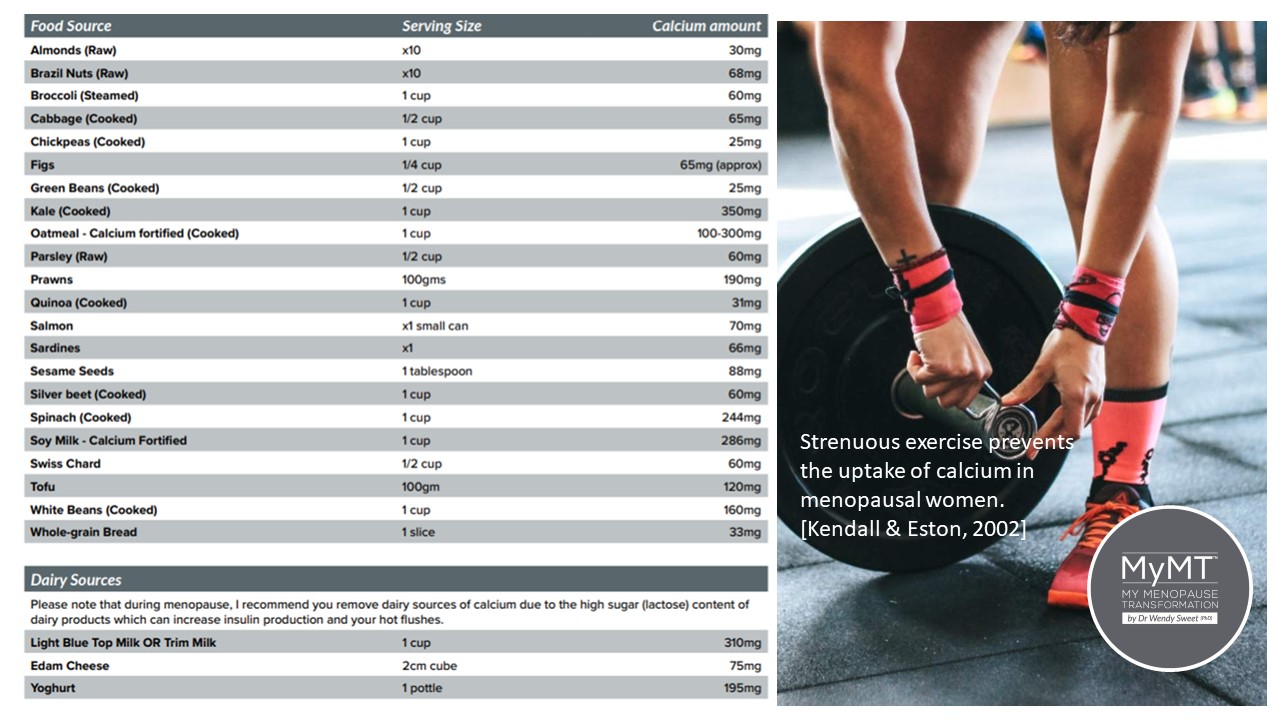
Calcium from Food
Whilst I have a focus on the traditional Mediterranean Diet on the MyMT™ programmes, typically this diet is lower in dairy products that the western diet. However, the Mediterranean Diet supplies enough calcium via feta cheese, low-fat milk and hard cheeses and good quality natural spring water.
Associate Professor Catherine Itsiopoulos, from Australia, is a world-expert in the traditional Mediterranean Diet, and her research spans decades. She talks about the differences between the Italian, Greek and Spanish Mediterranean dietary patterns, but how they all have around 2 servings of low-fat dairy products daily.
Following this research means that you can trust the MyMT™ Food Guides, which I’ve developed for women joining me on the 12 week online programmes. This guide has important information about calcium, along with other nutrients that the body needs for improving our health as we get older. I’ve have an example of the list below.
There are numerous symptoms that women experience in menopause, including restless legs and sore, aching muscles.
But as I always say, the ‘problem’ isn’t menopause – this is a natural event that all women go through. The ‘problem’ is that we need to change our lifestyle to accommodate this incredible stage of life.
That’s what the 12 week online MyMT™ programmes teach you to do – these differ depending on whether you desire weight loss or not, or if you are in post-menopause or you want to reconnect with exercise again. I hope you can join me sometime for your midlife lifestyle-change reset!
Dr Wendy Sweet (PhD)/ Member: Australasian Society of Lifestyle Medicine.
References:
Astrup, A. (2014). Yoghurt and dairy product consumption to prevent cardiometabolic diseases: epidemiologic and expereimental studies. Am. J. Clin. Nutr., 99; 1235S-42S
Bronner, F. & Pansu, D. (1999). Nutritional Aspects of Calcium Absorption, The Journal of Nutrition, 129 (1), 9–12.
Kendall B, Eston R. Exercise-induced muscle damage and the potential protective role of estrogen. Sports Med. 2002;32(2):103-23. doi: 10.2165/00007256-200232020-00003. PMID: 11817996.
Kim YS, Hong KW, Han K, Park YC, Park JM, Kim K, Kim BT. (2020). Longitudinal Observation of Muscle Mass over 10 Years According to Serum Calcium Levels and Calcium Intake among Korean Adults Aged 50 and Older: The Korean Genome and Epidemiology Study. Nutrients. Sep 18;12(9):2856.
Mailis A, Ang SB, Di Renna T, Kazatsker MM, MacGregor EA, Misasi G, Poli J, Simoncini T, Wolfman W, Nappi RE. Chronic pain at midlife. Climacteric. 2026 Oct;29(5):648-668. doi: 10.1080/13697137.2026.2722558. Epub 2026 Sep 9. PMID: 42714958.
Preedy, V. & Watson, R. (2020). The Mediterranean Diet: an evidence-based approach. Elselvier Academic Press: London, UK.
Romero-Parra N, Maestre-Cascales C, Marín-Jiménez N, Rael B, Alfaro-Magallanes VM, Cupeiro R, Peinado AB. Exercise-Induced Muscle Damage in Postmenopausal Well-Trained Women. Sports Health. 2021 Nov-Dec;13(6):613-621.
Straight CR, Ades PA, Toth MJ, Miller MS. Age-related reduction in single muscle fiber calcium sensitivity is associated with decreased muscle power in men and women. Exp Gerontol. 2018 Feb;102:84-92. doi: 10.1016/j.exger.2017.12.007. Epub 2017 Dec 13. PMID: 29247790; PMCID: PMC6411279.
Südhof TC. Calcium control of neurotransmitter release. Cold Spring Harb Perspect Biol. 2012 Jan 1;4(1):a011353. doi: 10.1101/cshperspect.a011353. PMID: 22068972; PMCID: PMC3249630.
Tonelli Enrico V, Vo N, Methe B, Morris A, Sowa G. An unexpected connection: A narrative review of the associations between Gut Microbiome and Musculoskeletal Pain. Eur Spine J. 2022 Dec;31(12):3603-3615. doi: 10.1007/s00586-022-07429-y. Epub 2022 Oct 29. PMID: 36308543; PMCID: PMC9617047.